Kluczynski Federal Building: Mies van der Rohe's Last Chicago Masterpiece
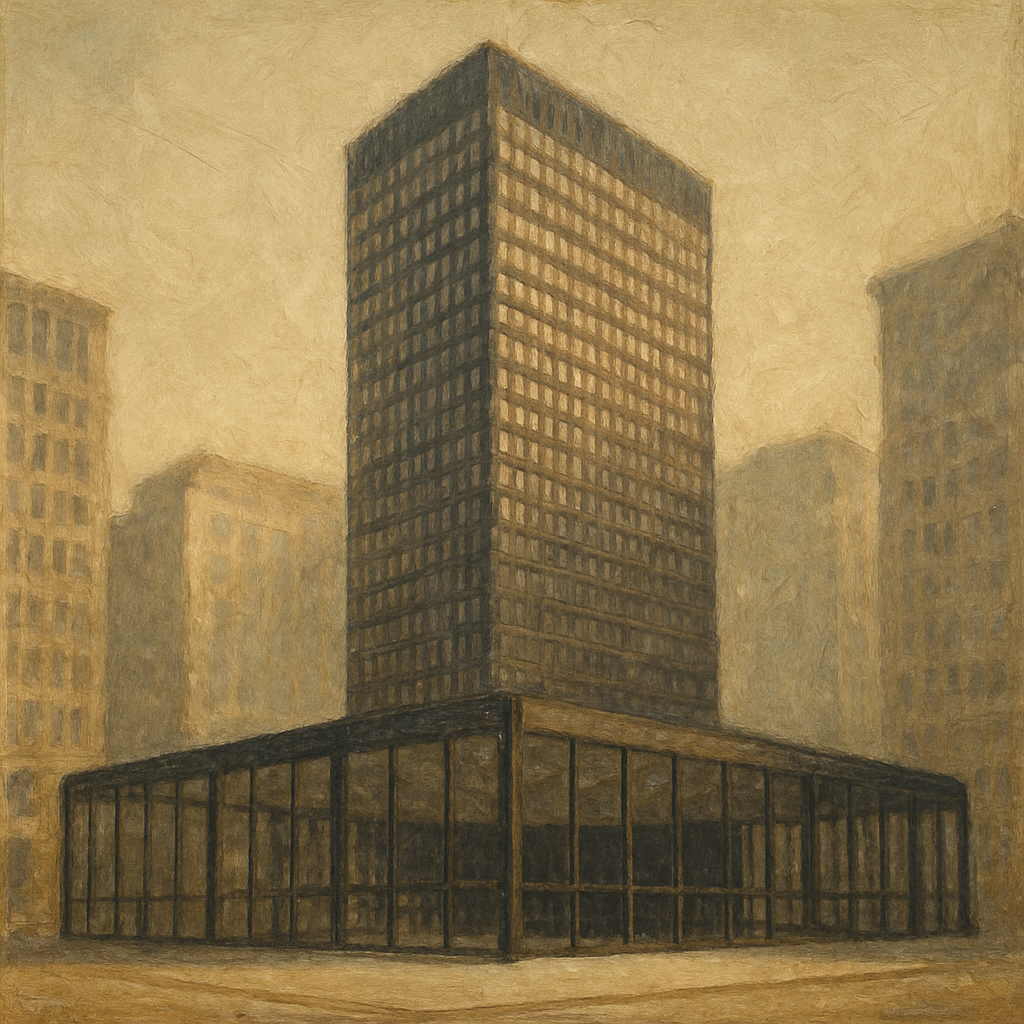
In 1974, the John C. Kluczynski Federal Building rose 562 feet above Chicago's Loop as the last structure Ludwig Mies van der Rohe would complete in his adopted city. This 45-story modernist tower, named for a U.S. Congressman, stands where an earlier federal building once anchored the heart of downtown.
On the corner of Dearborn and Adams, the Kluczynski Federal Building cuts a clean vertical line against the Chicago skyline. Its steel frame and glass curtain wall reflect Mies van der Rohe's signature aesthetic—the belief that less is more, structure made honest. When it opened in 1974, it completed the architect's vision for the Federal Center, a three-building campus that transformed a full block in the Loop.
The Last Mies in Chicago
Ludwig Mies van der Rohe had shaped Chicago's architectural identity for decades by the time the Kluczynski building rose. The German-born modernist arrived in 1938 and taught at the Illinois Institute of Technology while designing some of the city's most influential structures. The Kluczynski tower was his final commission in Chicago—a 45-story monument to the principles he had advocated throughout his career. At 562 feet tall, it remains one of the tallest government buildings in the United States.
Site and Succession
The Federal Center site itself carries Chicago's federal history. Before Mies's three-building complex arrived, the lot held the Chicago Federal Building, an ornate 1905 structure designed by Henry Ives Cobb. That earlier building came down to make way for the modernist vision. Today, the Kluczynski building anchors the complex alongside Mies's post office structure and the iconic Federal Plaza, where a monumental red Alexander Calder sculpture sits in the open courtyard.
A Working Monument
The building's purpose never changed: it houses federal offices and courtrooms, serving thousands of visitors and workers each year. Its austere beauty is functional—floor-to-ceiling windows flood interior spaces with light, while the structural system is expressed openly, hiding nothing. The plaza level remains a public gathering space, one of downtown Chicago's quieter corners despite its prominence.
Mies van der Rohe died in 1969, five years before his final Chicago building opened. The Kluczynski Federal Building stands as a late-career statement from an architect who believed that architecture should be clear, rational, and enduring. More than 50 years after its completion, the building's glass and steel frame reads as fresh as the day it was finished.
- chicago-loop
- modern-architecture
- mies-van-der-rohe
- federal-building
- downtown-chicago