New York City Hall's Civic Center: Where Government Built a Neighborhood
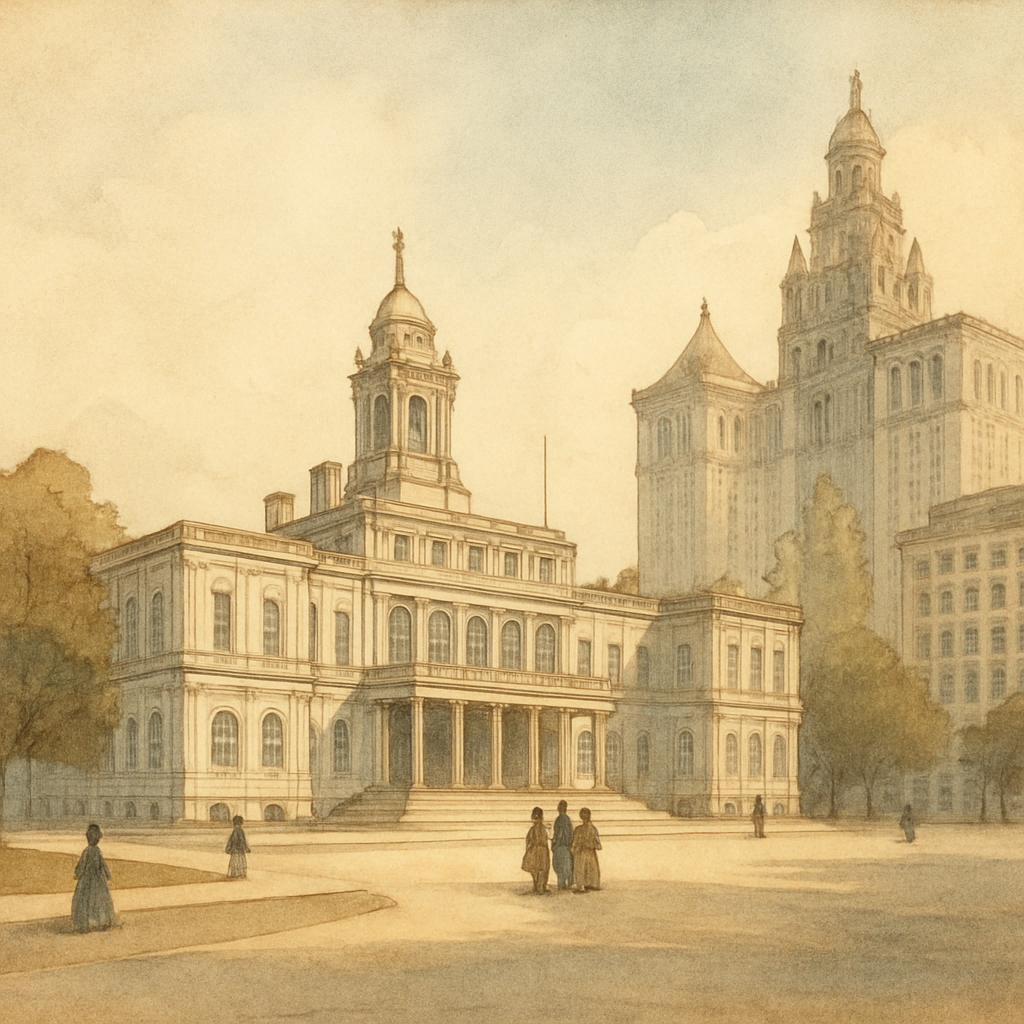
City Hall rises above Civic Center, a 20-block neighborhood in Lower Manhattan where the machinery of New York government has operated for nearly two centuries. Built around the seat of municipal power, the district consolidated courts, police headquarters, and administrative offices into a single dense precinct.
The Civic Center: Manhattan's Seat of Power
Since 1812, New York City Hall has anchored this neighborhood, its marble rotunda and cupola visible from blocks away. The building itself became the catalyst for the entire district: as the city grew, government agencies clustered nearby. By the mid-20th century, Civic Center had become the physical embodiment of municipal order, a place where ordinary New Yorkers conducted business in courtrooms, police precincts, and administrative offices.
The Layout and Landmarks
The district is bounded by Broadway on the west (where Tribeca begins), Worth or Bayard Street to the north (the edge of Chinatown), the East River and Brooklyn Bridge to the east, and Ann Street to the south (where the Financial District starts). Within these borders sit several major institutions: One Police Plaza, home to NYPD headquarters; Foley Square, a public plaza ringed by courthouses that handle civil, criminal, and appellate cases; and the Metropolitan Correctional Center.
The courthouses themselves—including the Thurgood Marshall U.S. Courthouse, the New York County Courthouse, and others—represent different architectural eras and legal jurisdictions, creating a layered geography of law and order.
A Neighborhood Defined by Its Institutions
Unlike other Manhattan neighborhoods organized around commerce or residence, Civic Center exists primarily as a functional zone. Foot traffic is heaviest on weekday mornings when court is in session; lawyers, defendants, witnesses, and jurors move between buildings. The area quiets considerably after hours and on weekends. This rhythm has defined the neighborhood since its formal consolidation.
The surrounding streets—Pearl, Nassau, Leonard, Chambers—have filled in over decades with legal services offices, small restaurants catering to courthouse workers, and municipal parking. A few residential buildings exist, but Civic Center remains fundamentally defined by the work that happens within its borders.
Then and Now
The district's institutions have endured while the city transformed around them. Chinatown to the north, Tribeca to the west, and the Financial District to the south have all undergone profound shifts in character and real estate value. Civic Center itself remains largely unchanged in purpose, though individual buildings have been renovated and some have closed—the Metropolitan Correctional Center, for instance, held inmates for decades before closure in 2021.
Walked past one of the courthouses during a trial? What brought you to Civic Center?
- lower-manhattan
- civic-center
- new-york-city-hall
- foley-square
- manhattan-neighborhoods