The Great Police Riot of 1857 at New York City Hall
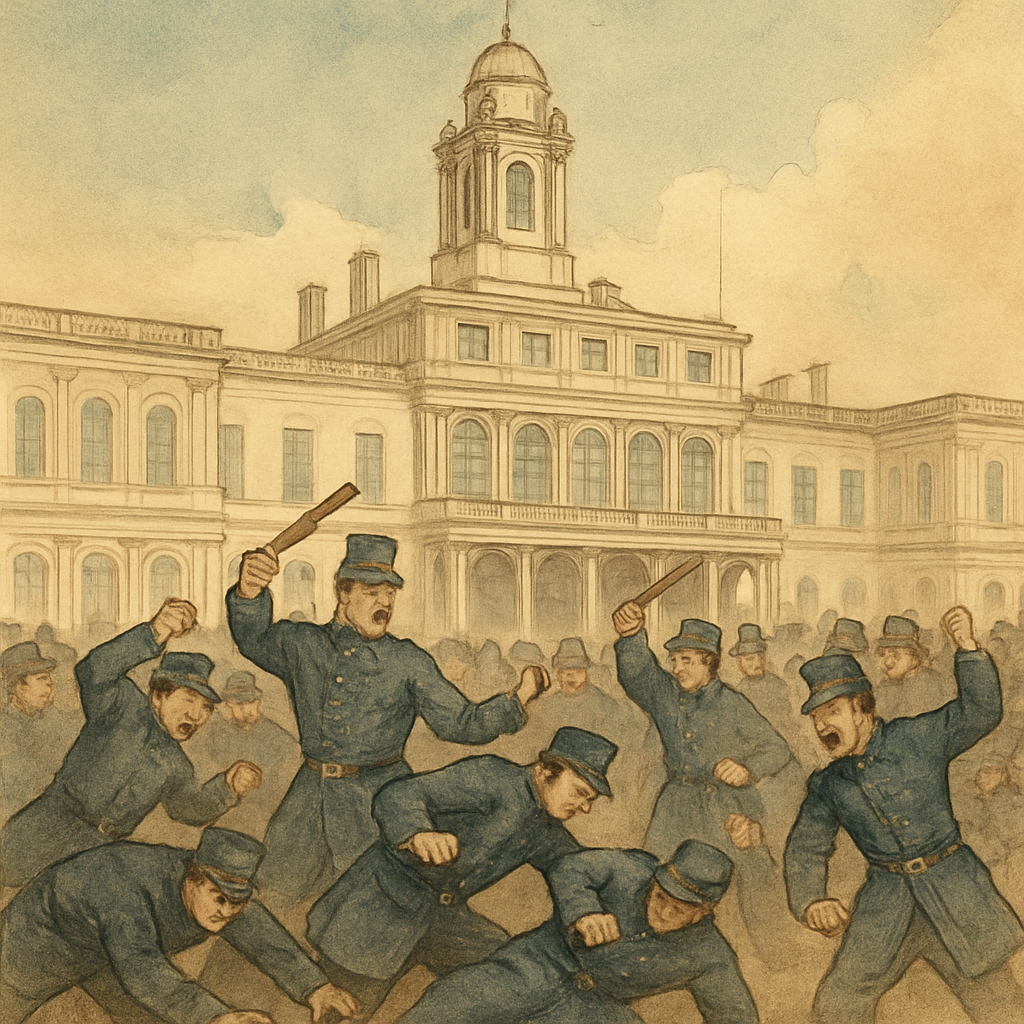
On a June afternoon in 1857, two police forces faced off in front of New York City Hall—one dissolving, one ascending—in a violent struggle that exposed the rot of machine politics and the chaos of a city without a unified constabulary.
The Appointment That Started It All
Mayor Fernando Wood's decision to appoint Charles Devlin as city street commissioner in 1857 seemed routine on its surface. But whispers circulated through the corridors of City Hall: Devlin had purchased the position for $50,000, a staggering sum that fueled suspicion of corruption. The appointment infuriated Daniel Conover, the rival candidate backed by a faction of the old guard, and his supporters in the recently dissolved New York Municipal Police.
New York City had been in flux. The Municipal Police, which had served the city for years, was in its final days, officially disbanded to make way for the newly formed Metropolitan Police—a state-controlled force meant to bring order and remove law enforcement from the grip of city politics. The transition was supposed to be clean. It was anything but.
June 16: Violence at City Hall
Tension erupted on June 16, 1857, as members of the old Municipal Police clashed with the incoming Metropolitan officers in front of City Hall near the intersection of Broadway and Park Row (40.712°N, 74.006°W). What began as an angry confrontation escalated into a full riot. Officers from both forces brawled in the streets, throwing punches and wielding clubs. Bystanders watched in shock as law enforcement itself became lawless—the very institution meant to protect order had fractured into warring camps.
The riot lasted hours, drawing crowds and attracting the attention of militia units. Eventually, state officials and military intervention restored a fragile calm. The damage was real: wounded officers, humiliated city leadership, and a public deeply shaken by the spectacle of their police force at war with itself.
A Turning Point for Governance
The Great Police Riot exposed the fundamental flaw in allowing local mayors to control law enforcement: patronage and corruption flourished unchecked. Wood's brazen appointment—whether or not the $50,000 rumor was true—symbolized an era when public office was treated as a commodity for sale to the highest bidder.
The riot ultimately vindicated the state's push for centralized control. The Metropolitan Police grew stronger in its aftermath, while the old Municipal Police faded into history. Yet the lesson transcended police reform: New York's nineteenth-century politics had revealed how deeply institutional corruption could run, and how desperately the city needed structural checks on executive power.
Today, City Hall still stands at the same spot where officers clashed that June afternoon. The building's classical architecture suggests permanence and order, but the riot of 1857 remains a reminder that even the institutions we trust to uphold law require constant scrutiny and reform.
Source: Wikipedia — CC BY-SA 4.0
- new-york-city-history
- 1857
- police-reform
- city-hall
- urban-governance
- political-corruption